(This post contains spoilers.)
Because I have great intellectual courage and faith in my own ideas, I will open with a disclaimer. I am not here to quibble about the “historical accuracy” of The Great. Frankly, I couldn’t care less about whether the show reproduces a strictly accurate narrative of Catherine the Great’s life and her marriage to Peter III. It’s satisfying that the show did not shy from casting actors of color. And one of its most delightful moments is when a Russian Orthodox archbishop quite seriously approaches one of the court gentlemen with the offer of spiritual guidance, and then says abruptly, “I see you occasionally huddled with the empress, and wonder if you’re trying to butt fuck her.”
Nevertheless, there remains something to be desired in the world of The Great. One of the greatest joys of historical fiction as a genre is the way in which it allows us to inhabit historical intellectual spaces. It is at its best when it moves beyond merely costuming actors in corsets and into a realm that really shows, rather than tells, what people used to think of themselves and the universe. There is nothing more boring than shows that use actors in powdered wigs and knee-breaches to more or less directly rehearse the latest trend on Twitter.
Of course, this is fairly easy to accomplish if your work is serious and more or less straightforward, as in a work like Greta Gerwig’s Little Women (2019), Baz Luhrmann’s The Great Gatsby (2013), or even Robert Eggers’ The Witch (2015). Because these films in their different ways forego the need to make their audiences laugh, they are free to render characters who take themselves seriously, and therefore fairly transparently showcase the frame of reference that structured their intellectual worlds. It is a much more complex proposition in the realm of comedy. Some recent shows have made forays into comedic historical fiction have failed—painfully. Almost every single joke in the 2020 series Dark Ages: A Miracle Workers Anthology falls into one of two categories: actors in period costume using incongruously modern vernacular, and smugly self-satisfied references to how inegalitarian medieval European society was (implicitly suggesting, I suppose, that our own is an egalitarian utopia). It is, frankly, lazy. I dislike this kind of historical fiction because it does a disservice to both the past and the present: the past, because it flatly renders historical evils without showing how or why they existed, and the present, because it flatly rehearses self-satisfied notions of our own progressiveness without admitting the complex ways in which we remain mired in the very intellectual limitedness that it mocks.
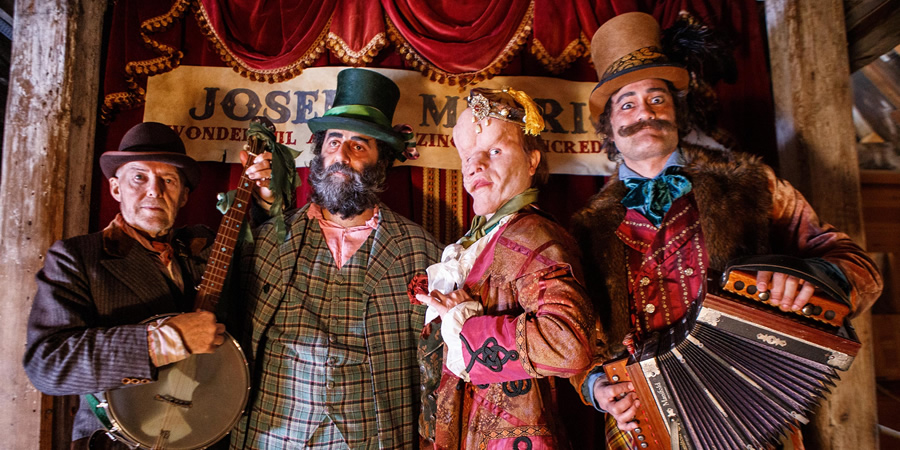
On the other hand, some have marvelously risen to the challenge of historical comedy. Taika Waititi’s Jojo Rabbit (2019), although quite silly, is sprinkled with jokes that humorously and accurately convey the intellectual moment of Nazi Germany. Rebel Wilson’s announcement at a Hitler Youth camp, in a thick German accent, that she “has had eighteen children for Germany,” is a hilarious and obviously ridiculous exaggeration. But it also quite cleverly demonstrates the very real obsession that the Nazis had with fertility and the relationship that they perceived between this and the so-called “health” of their “homeland.” Similarly, Kevin Cecil and Andy Riley’s 2019 series The Year of the Rabbit is full of such delightful moments. Joseph Merrick (perhaps better known as “The Elephant Man”) features as a recurring character. In his real life, Merrick’s disability forced him into selling himself as a freak show exhibit to make money and avoid the workhouse; in The Year of the Rabbit, he is the fearless, flamboyantly gay, and unwaveringly self-confident master of his own freak show. When one of the characters pulls off a cloth covering his face in public, he dramatically protests, “People won’t pay if they can see me for nothing!” Even though this representation of Merrick is wildly “historically inaccurate,” it accurately lampoons the vapid and dehumanizing curiosity that funded the real-life freak shows of which the real-life Merrick was a part.
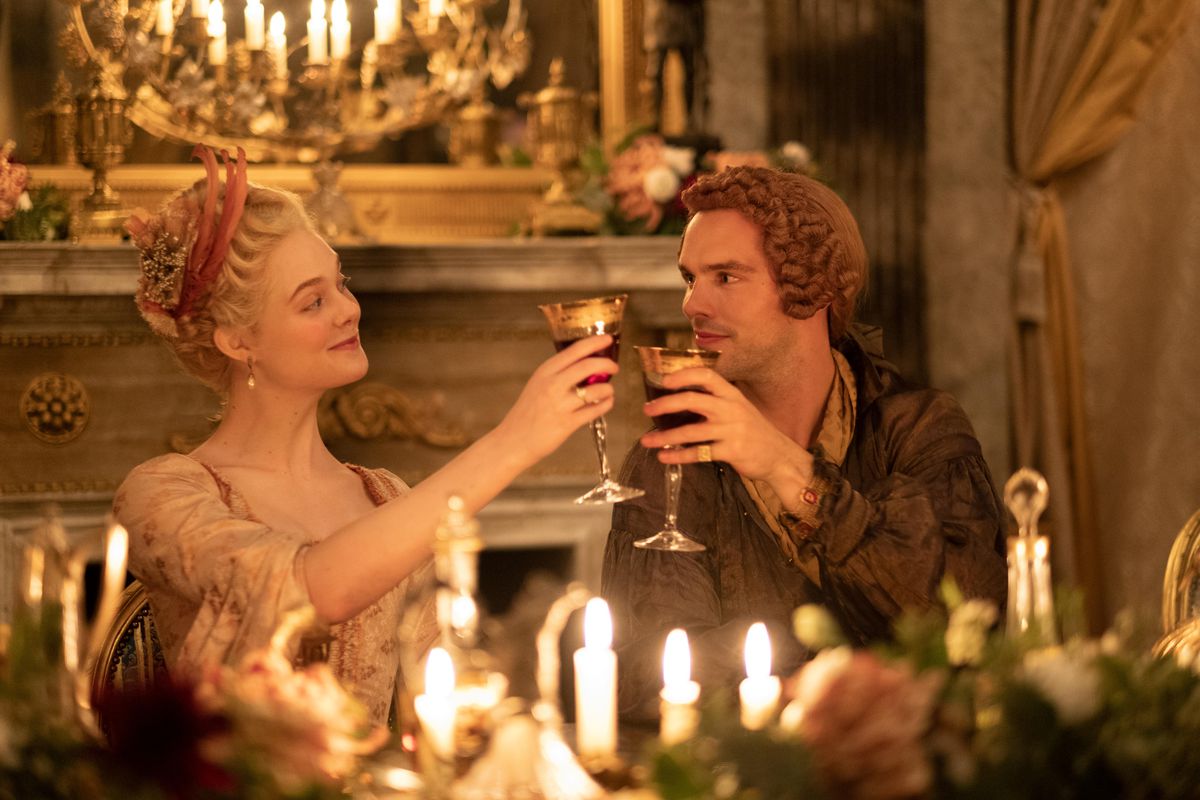
Where, then, does The Great fall on this continuum? Truthfully, somewhere in the middle. I originally decided to watch it because I absolutely loved The Favourite (2018), and Tony McNamara was one of the primary writers for both. But The Great decidedly falls short of The Favourite. They are both designed to irreverently buck the prim conventions of historical drama, but where the latter maintains a close and productive relationship with its time and place even as it makes it the subject of mockery, the former takes the conceit so far as to make it overly simplistic and even, at times, immature.
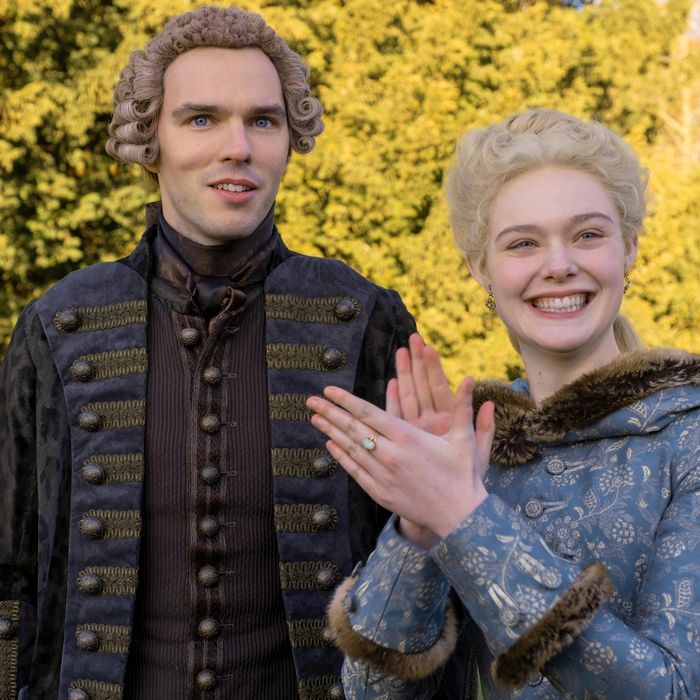
There is, to be fair, a lot that The Great does quite well. Down the line, the performances are spectacular. And all of the secondary characters are tastefully complex and gorgeously developed. The writers avoid the laziness of dividing the characters simply into those who are “good” and those who are “evil.”
This complexity unfortunately falls apart, however, when it comes to the main characters, Catherine (Elle Fanning) and Peter (Nicholas Holt). Holt’s Peter, while performed with great skill, is literally cartoonishly horrible to a point that begins to defy all reason or interest. Attempts to add depth to his character, such as sundry references to the cruelty of his mother and a brief moment of interest in self-improvement around the middle of the series, do not do enough to amend the shallowness that characterizes the majority of his writing. I would imagine that this was a deliberate choice—as has already been observed in The Atlantic, Peter III is basically supposed to be Trump, and indeed Trump, with his shallowness, cruelty, narcissism, and complete lack of interest in the truth, is himself a cartoonishly horrible personage. But the fact of the matter is that evil is never purely evil for its own sake. All people have reasons why they choose to behave the way that they do; just because all of us only have access to Trump’s bizarre public persona doesn’t mean that there is no more complexity there that is hidden from our view. And in The Great, a show which otherwise provides a high level of psychological insight, to foreground Peter III as evil because he’s evil because he’s evil is to miss a poignant opportunity to engage with and explore the larger reasons behind why people abuse power.
It is perhaps because of the weakness of Peter’s development that Catherine’s development seems similarly to fall flat. Like Holt, Fanning brings her character to life with proficiency and effortless charm. But acting opposite the flat caricature of Peter III, and without serious engagement in her historical setting, Catherine becomes at times little more than bubbly mouthpiece for twenty-first century progressive politics in eighteenth-century garments. In the face of the cruel and regressive misogyny of her husband and other characters like the archbishop, she responds with wry quips like “Women are people” that are glaringly self-evident to us contemporary progressives (at whom the show is clearly aimed), but jarringly anachronistic in the voice of a character that lived almost three hundred years ago. Of course, since time immemorial there have been women who recognized the cruelty of patriarchy and sought to rectify its injustice. But what we now call feminism has a long and colorful intellectual history, and to obscure it by papering over it with today’s language does it a disservice. Actually putting in the work to get a more genuine feeling for how someone in Catherine’s position would have thought about womanhood and power would have not only been more informative, but also much more entertaining than simply rehashing ideas that most of us—thanks to the hard work of innumerable activists who have lived since Catherine’s time—take entirely for granted as true.
This, then, is the opportunity that The Great clearly misses out on. As many recent works have proven, comedic historical fiction can be an opportunity for lively and enjoyable revisionism. But by falling into the trap of lazy historical fiction, Hulu’s latest original remains immature and fails to realize its full potential.
 Jason Emmett Collins